With nearly two decades of family law experience, Mark Hall has guided clients through some of life’s most difficult transitions with compassion, composure, and a steady hand. Based in Cordell & Cordell’s Jacksonville office, he brings calm to challenging situations and is dedicated to helping clients achieve their best possible outcomes. Mark’s clients value his ability to provide clarity and protection while helping them move toward happier, more stable lives.
Stephen Josephik is a skilled litigation attorney who brings diverse legal experience to his family law practice at Cordell & Cordell. A native of Tampa, he has served as an Assistant State Attorney and practiced civil litigation and family law across several Florida jurisdictions. He values the opportunity family law provides to advocate in court while making a meaningful impact on his clients’ lives.
“I got into family law because it combines two things I value most: the ability to advocate in court and the opportunity to make a meaningful difference in people’s daily lives.”
Read through our Florida divorce and child custody articles to gain a better understanding of the road ahead. Educating yourself about the divorce process in Florida will improve your ability to communicate with your divorce lawyer, which goes a long way toward helping you reach your goals in a Florida family court.
In Florida, a divorce is called a “dissolution of marriage.” It is a no-fault state, so the only requirement is for at least one of the people involved to plead and show that the marriage is irretrievably broken. Once you file for divorce, you must determine how marital property and care for the children involved will be broken down. A court will determine distribution if an agreement with your ex-spouse cannot be reached.
Those who wish to pursue dissolution of marriage in Florida (Florida law § 61.021) must show that at least one of the parties has lived in the state for the last six months prior to filing the petition. The person petitioning must show proof of residency to the court prior to the court taking up the case.
In Florida, it is not necessary to prove one spouse caused the decline of the marriage. Florida is one of several states that has eliminated fault as grounds for the dissolution of marriage. Rather, the only statement either party needs to make is that the marriage is irretrievably broken.
Notably, the reason for the irretrievable breakdown could be considered by the court when deciding if one party should receive alimony from the other. It may also be used to divide marital assets and debts and in the creation of a parenting plan.
The state does recognize the dissolution of marriage on the grounds of mental incapacity. One party may file a petition on the grounds of mental incapacity of the other if the person has been adjudicated incapacitated for at least three years prior to filing the petition.
Florida is an equitable distribution state as opposed to a community property state. The court must begin with the premise that allmarital assets and debts are to be divided equally. However, the court may divide assets and debts unequally to achieve equity and justice between the parties.
Marital Property
Marital assets and debts include:
Any asset acquired or debt incurred by either party or both parties during the marriage
Interspousal gifts
Income earned during the marriage
Enhancement in value and appreciation of non-marital assets resulting from the efforts of either party during the marriage or from the expenditure of marital funds
If marital funds are commingled with non-marital funds so as to become untraceable, a presumption is created that the spouse made a gift to the other spouse of an undivided half interest in the funds. The presumption may be overcome by clear and convincing evidence that no gift was intended.
Non-Marital Property
Non-marital assets and debts include:
All assets acquired and debts incurred by each party prior to the marriage
Assets acquired in exchange for pre-marital assets
All income derived from non-marital assets during the marriage unless the income was treated, used, or relied upon by the parties as a marital asset
Assets acquired by inheritance,
Passive appreciation of non-marital assets
Here are some additional helpful articles for property division.
There is no legal term “custody” in Florida, and the state has abolished primary and secondary residential parent designations. Both parents are entitled to frequent and continuing time-sharing with their children, and the court will order a time-sharing schedule that is in the best interests of the child based on statutory factors.
A Florida Supreme Court Approved Parenting Plan must be included in all final judgments of dissolution of marriage. The Parenting Plan includes provisions for:
The division of costs for extracurricular activity
Out-of-state and out-of-county travel
Transportation and the exchange of children
Communication between the parents and the parents and children
Decision-making
Parental responsibility, which involves making major decisions regarding the child’s education, health care, and general welfare, is presumptively shared by the parents. Neither party can relocate with a child more than 50 miles from that parent’s residence without the consent of the other parent or a court order.
Both parents are responsible for child support. Child support is statutory and based on a mathematical calculation. Once the statutory child support obligation is determined, the parties each pay a percentage based on their respective income. Health insurance, uncovered medical expenses, and necessary daycare costs are also factored into the calculation, as is the percentage of overnights.
Each parent must attend a court-approved family stabilization course that focuses on how the dissolution will affect children and how parents can alleviate the trauma of a broken family.
Child Custody Shared Parenting Arrangments in Florida
Also notable is that the state provides some clarity on the types of time-shared parenting that could be included in a parenting plan. The ultimate decision the court makes could include one of these arrangements:
Weekly arrangement: Parents rotate week-to-week with custody of the child. When parents have similar work schedules, this simple and direct schedule may be an option.
Two weeks: Like weekly arrangements, but for two weeks, this method allows a child to spend two weeks with each parent before switching to the other.
4-3-3-4 schedule: This schedule follows a process in which the child will rotate between parents at these intervals: four days with one parent, three days with the other parent, three days with the first parent, and four days with the second parent.
2-3-2 schedule: This method follows a weekly schedule in which the child will spend time with one parent for two days, the second parent for three days, and then two days with the first parent again. The next week it is reversed, allowing both parents to receive equal time.
2-2-5-5 schedule: A more elaborate option, but one that follows a two-day stay with each parent followed by a five-day stay with each parent. This method repeats over time.
To determine child custody in Florida, the court will consider all factors deemed relevant to the case, including:
The child’s preference
Each parent’s willingness to meet the needs of the child
The parents’ capacity to provide support for the child, including for school and extracurricular activities
Where the child’s school is located
The parents’ ability to act on the child’s needs instead of their own desires
The ability and willingness of each parent to maintain a close relationship with the child
The moral fitness of each parent and how it impacts the child both directly and indirectly
Parents can develop a timesharing plan that meets their goals if both parents agree as a component of the divorce process. The court will still review the parenting plan to verify it meets all requirements and supports what is in the best interest of the child.
In Florida, both parents have a legal obligation to support their child based on their ability to do so. To facilitate this, Florida uses the “Income Shares Model,” which means the courts will estimate how much each parent would be spending on their child if they were still all living together in a single household.
It’s important to note that child support operates independently from visitation. This means that if the paying spouse misses a child support payment, it does not warrant denying them visitation as a punishment. All court orders, including child support and visitation, must be obeyed to the letter.
The need of one spouse and the ability of the other spouse to pay
The length of the marriage
The standard of living during the marriage
The age and physical and emotional condition of each party
Financial resources of the parties
Contributions to the marriage
The earning capacities
The responsibilities each party will have regarding their minor children
Any other factor necessary to provide equity and justice between the parties
The different types of alimony include:
Permanent
Rehabilitative
Bridge-the-gap
Lump sum
Nominal
Durational
Permanent alimony is presumed for long-term marriages, and there is a presumption against permanent alimony for short-term marriages. Definitions for long-term and short-term vary throughout jurisdictions. However, as of July 1, 2010, a short-term marriage is defined as a marriage lasting less than seven years, and a long-term marriage is defined as a marriage lasting 17 years or more.
Continue reading to view additional articles to educate you on spousal support.
Cordell & Cordell works with clients across the country to advocate for rights in family court. Our legal team in Florida has extensive experience working within the local laws, so you can confidently approach your case with an advocate on your side. Take a look at what some of our previous clients had to say about our services.
“Cordell and Cordell has it figured out and streamlined. I liked that I could see everything on the website including documents I had turned in. [My attorney] was great. She was attentive and responsive. She was on top of everything.” — Richard G.
“[My attorney] was great! I believe I would have been better off today had I used your services from the onset.” — Edward S.
Your Trusted National Family Law Firm
At Cordell & Cordell, we know that family courts are often biased against men and fathers, so we serve as advocates for the disadvantaged. Get in touch with our team today by calling 866-323-7529 or by filling out our online contact form to schedule an an initial consultation.
*This page serves as a resource and is not to be taken as legal advice.
Cordell & Cordell Tampa divorce attorney Lisa F. Karges recently received board certification in the area of Marital & Family Law from the Florida Bar, a designation earned by just seven percent of eligible Florida Bar members – approximately 4,800 lawyers.
Board certified lawyers have met the Florida Bar’s highest standards for special knowledge, skills and proficiency in various areas of law and professionalism and ethics in the practice of law. Certified lawyers’ experience and competency have been rigorously evaluated. Board certifications stringent requirements for legal expertise and professional conduct give the public objective standards by which to evaluate attorneys.
Certification is the highest level of evaluation by the Florida Bar of the competency and experience of attorneys in the areas of law approved for certification.
In addition to being board certified specialist in Marital & Family Law, Ms. Karges was named a Rising Star in the family law practice area from 2014-17 by Super Lawyers, a Thomson Reuters rating service of outstanding lawyers. She earned her Juris Doctor from the Florida Coastal School of Law and graduated cum laude with a certification in family law and advanced legal writing.
Here is a common example about the lack of dads rights in Clearwater, Florida.
A dad living in Clearwater is served with divorce papers. In those papers, his estranged wife asks for child support for their minor child. The dad assumes that fathers rights laws will ensure his child support payments will be based on his current minimum-wage salary. He decides that he doesn’t need an attorney and doesn’t participate in the divorce proceedings.
On the day he receives his final divorce decree and is reading through the order, the dad is shocked to learn that his child support amount was calculated against a salary that is much higher than his. What happened to fathers rights in Clearwater, Florida?
A recent Florida law states that if a father fails to participate in divorce proceedings or is voluntarily unemployed or underemployed, his fathers rights on child support calculations will be based upon the U.S. Census Bureau’s median wage for full-time workers. This doubled the nonparticipating dad’s wages.
Family law is constantly changing. If you’ve been served with divorce papers, you need a dads’ rights attorney in Clearwater to keep you from paying more in child support than you can afford. Call the Clearwater fathers’ rights attorneys of Cordell & Cordell at 1-866-DADS-LAW.
Clearwater Dads’ Rights Resources | Florida Fathers’ Rights Resources
Thankfully, Florida is moving in the right direction with a new law acknowledging what fathers have been saying for years: they are more than their wallets to pay child support.
In this article, we’ll cover the ins and outs of Florida child support laws, what exactly the new child support laws mean for Florida fathers, and how you can fight for your right to take care of your child beyond child support.
To schedule a consultation with Cordell & Cordell, call us at 866-323-7529 (323-7529).
What Are Florida’s Child Support Laws?
In most cases, child support is mandatory in Florida. The purpose of child support is to make sure that both parents are still financially responsible for the child, even after a divorce. Child support can also be imposed on a parent once paternity has been determined, even if that parent did not know of the child’s existence.
In Florida, a person who is obligated to pay child support is called the “obligor parent,” and the person entitled to receive child support is called the “obligee parent.” When parents are married, they have a legal obligation to support their children. This responsibility remains even when the parents divorce or if the parties have never been married. Both parents must continue to financially support the child until they turn eighteen (18) years old, or if they are still in high school at the age of eighteen (18) years old, the child support obligation will continue until the child graduates from high school.
The Florida Department of Revenue oversees child support payments. It helps Florida citizens locate parents, establish paternity, determine assets, and establish and modify child support orders. The department monitors payments and helps a parent take action if the other parent does not pay their support on time. It can also receive and distribute payments. If needed, it also offers parenting classes.
Another term frequently used in child support issues is the term “guidelines.” This term refers to the guidelines which are set forth in Florida law for the courts to use when calculating the amount of child support owed. Learn more about the specifics of the Florida child support laws and guidelines below.
New Florida Child Support Laws in 2024
In July 2023 Florida passed a new law (Statute 742) which gives unmarried fathers automatic parental rights that previously only the mother of a newborn would receive. Fathers can now immediately be active participants in their children’s lives.
Previously, unmarried mothers were given the exclusive right to be the child’s “natural guardian” with 100% of parenting rights at birth. Unmarried fathers were only given the right to pay child support and perhaps gain more rights if they brought the case to court.
How Can a Father in Florida Establish Paternity?
At birth: At the Hospital
If parents are married, the father’s paternity is established and no action needs to be taken.
If parents are unmarried, paternity can be established voluntarily by both parents.
Age 0 – 18 years: By Legitimation or Acknowledgement
If a child is born to unmarried parents who later marry, paternity can be established when the parents apply for a marriage license.
In the case of parents not being married, paternity can be voluntarily established by both parents.
Age 0 -18 years: By Order
If paternity had not previously been established, it can be established through a legal court order.
Child custody and child support are two different determinations. Child custody establishes who will have legal and/or physical custody or, as we term in Florida, parental responsibility for timesharing of the child. These can be joint, where the parents share responsibility, or it can be sole, where one parent is mostly in charge of the child. In general, the non-custodial parent will end up making child support payments to the other parent. Determining custody is generally done through Florida family courts.
Determining who pays child support and the amount that is owed can be a difficult task. When making these decisions, the courts follow the Income Shares Model that considers several monetary factors of both parents, including:
Wages and salary
Bonuses, commissions, and tips
Disability benefits
Spousal support
Worker’s compensation
Social Security payments
Retirement and pension plans
Property ownership
Unemployment assistance
Other forms of compensation through self-employed or contractor work
After the total amount of a parent’s gross wages is calculated, deductions are subtracted from the amount. These include taxes, other spousal support, and any additional child support payments. This net amount is then used to determine the total amount of money you need to pay by using specific state-mandated guidelines.
In the event the other party is unemployed, underemployed, or not making as much as you potentially could in an attempt to lower child support payments, the court may “impute” income. In other words, if you are intentionally not working at your true capacity, the court may calculate an appropriate salary for you as if you were working to determine the amount of support owed. However, this is only used when the reduction in hours or pay is at the discretion of the party. This is used to help the receiving party when the paying party tries to conceal their true income to pay less child support.
Can Florida Child Support Orders be Modified?
To modify child support orders in Florida, you’ll need a substantial change in circumstances. You can file a petition anytime, and it will result in a change of at least 15% or $50, whichever is greater. A request to modify child support could be related to changes in:
Income status
Job status (new job or unemployed status)
Disability status
Additional child or other support orders in effect
One of the greatest challenges faced is that the income used in the original proceedings is likely incorrect. Oftentimes, attorneys try to “crowbar” numbers and manipulate child support to come out the way they want. Later, during a modification, they might not meet the threshold because the original documents don’t reflect accurate income.
What About Florida Child Support Deductions?
As you can see, almost any income source can be considered and will be included when calculating child support. However, there are still several deductions that a party may qualify for, which would lower their child support payments. While this is not an exhaustive list, some examples of deductions include:
Federal, state, and local income tax deductions
Retirement payments
Health insurance payments, except for those concerning the minor child
These deductions lower the total amount of income earned by a party that the court can use to determine their obligation of child support payment. This becomes especially important when the court calculates the net income of both parents.
When Does Child Support End in Florida?
Once child support is determined, parents will continue to pay the set amount until the child turns 18. Some special circumstances may exist that extend the length of payment, like graduation from high school after the age of eighteen (18) or if the child has a disability.
Child support laws in Florida provide that the court “may order either or both parents to support a child” until either the child turns 18 or graduates from high school (the later of the two), the child is emancipated by marriage, the disabilities of the child are removed, or the child dies. However, as further discussed below, if the child is deemed to be disabled by the court (physically or mentally), then the child may receive support indefinitely.
How Can You Stop Child Support Payments in Florida?
It is possible to alter child support payments. This, too, has specific qualifications that must be met, and it can be hard to change payment calculations or schedules. It is usually only done when one parent can show that the other has had a major and ongoing financial change. Examples include a change in job status or coming into a substantial amount of money, like from an inheritance or winning the lottery.
Stopping child support payments in Florida can be even more difficult, but it can be done. Some ways to do this include:
An agreement between the parents: If both parents agree, child support payments can be waived or stopped. It is important to note that a judge has the right to supersede this agreement if they feel it is unfair. This means that a judge can still order child support even if both parents state they do not need it. In practice, the judge tends to follow parental agreements unless they suspect one parent has not entered the decision in good faith.
Give up your parental rights: A parent can decide to do this but they will have to follow specific state guidelines. If a parent surrenders their parental rights, they do not have to pay child support anymore. However, this also means that they no longer have any say in what the child does, and they cannot request visitation rights. In some instances, the custodial parent may ask the non-custodial parent to give up their rights. This is generally done when the custodial parent either has a new partner that wants to legally adopt the child, or they do not want the child to know the other parent.
Terminating any child support agreement: The support agreement will be void when the child turns eighteen (18) unless there are special circumstances. It is also automatically terminated if one parent dies. The court could also terminate the agreement if you lose your job or if you go to prison. In these cases, the court will more than likely be inclined to alter payments rather than terminate them altogether.
How Are Florida’s Child Support Guidelines Applied?
Once the court has calculated your total income, the judge will use this number to determine how much child support is owed based on the Child Support Guidelines from Florida Statute 61.30.
Even though the guidelines seem like a rigid set of rules that the court must follow, they have some flexibility when determining the amount of child support in a case. The court automatically has the discretion to set the child support five percent above or below the amount in the guidelines.
Any deviation from the guidelines greater than five percent must have a written finding to support why the different amount is warranted. For example, if a party’s child support obligation pursuant to the guidelines is $500, the court can automatically adjust the amount to $475 or $525 based on what they find is suitable for the given situation.
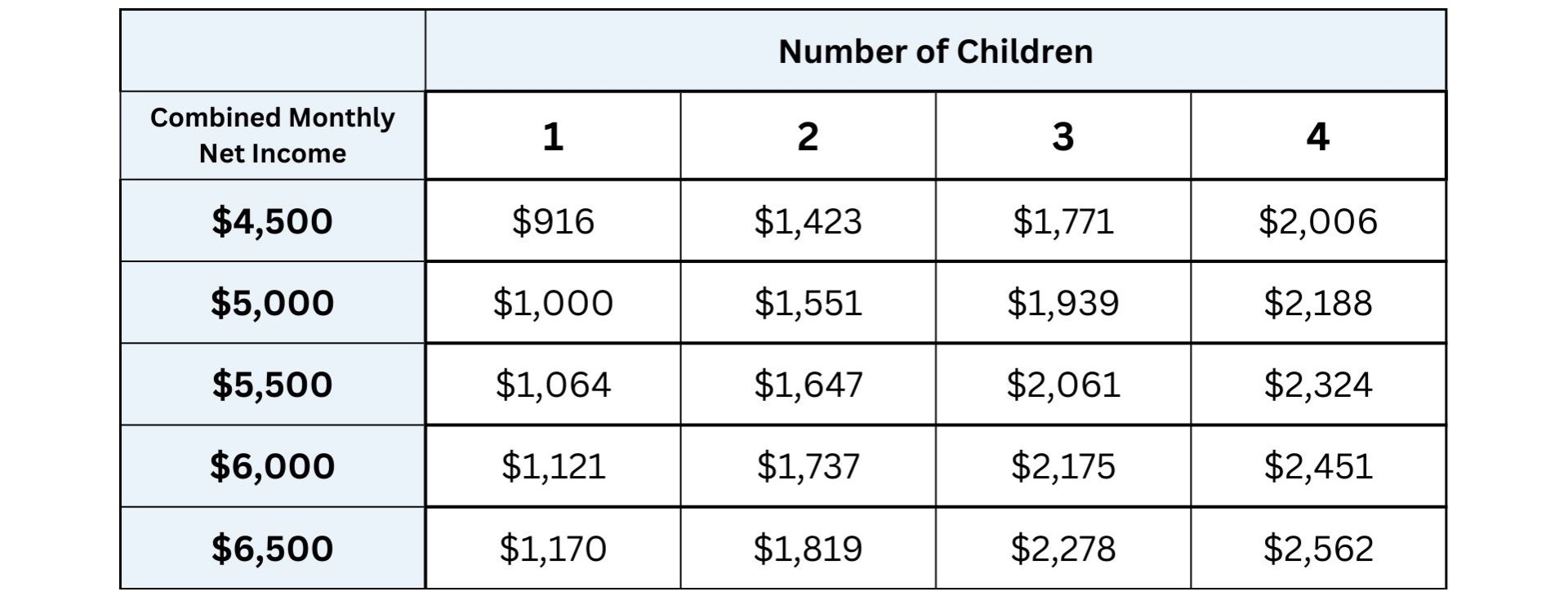
In addition to the court’s discretion regarding the amount of support owed, these figures also automatically adjust based on how many children the couple share. For example, if the parties have a net income of $2,000, the guidelines state $442 in support will be granted for one child, $686 for two children, $859 for three children, and so on.
Once the amount of support has been determined, the court will find how much each party will be responsible for. The paying parent will pay a portion of the amount found by the child support guidelines based on their percentage of the total net income.
If the guideline determines $500 as the total amount needed for the child and both parties are earning an equal amount, each parent would be responsible for $250 each month; however, if the non-custodial party makes 60% of the party’s net income, they would pay 60% of the child support amount: $300.
For combined monthly net income greater than the amount in the guidelines schedule, the obligation is the minimum amount of support provided by the guidelines schedule plus the following percentages multiplied by the amount of income over $10,000.
No two cases are identical, which makes it crucial to have proper legal guidance when understanding your child support rights and responsibilities. Contact Cordell & Cordell’s child support attorneys for men to learn your options.
How Does Child Support Enforcement Work in Florida?
Custodial parents can seek assistance from the Clerk’s Office. If payment is overdue by 15 days, the Clerk’s Office will send a Notice of Delinquency. If unpaid within 20 days, the respondent will receive a judgment. If nonpayment still occurs, the case is escalated and more serious consequences will occur.
Noncustodial parents who owe $5,000 in past due support and four prior convictions of nonpayment amounts to a felony. Some may receive jail time.
Can There Be Deviation From the Child Support Guidelines in Florida?
The court may determine that the guidelines are unjust or inappropriate and may deviate. The court may deviate from guidelines if the evidence shows that the “best interests” of the child justify a deviation. According to Florida’s child support laws, the court can basically consider anything that is relevant, including a number of statutory factors.
For example, the court can consider the following:
The age and needs of the child
The ability of the parents to contribute to supporting the child
The amount of time and possession of and access to a child
Financial resources available to support the child,
Childcare expenses
Special or extraordinary education
Health care
Other expenses
Can Child Support Be Ordered Retroactively in Florida?
If an obligor has not been paying child support, the court can order retroactive child support to be paid to the obligee. In determining the amount of retroactive child support, the court must look to the “net resources of the obligor during the relevant time period” and the following factors:
Whether the mother had made any attempts to let the father know of his paternity (or the possibility of)
If the father knew of his paternity (or the possibility of)
Whether an undue hardship will be imposed on the father
If the father had provided actual support or necessaries before the filing of the action
The court can order retroactive child support to be paid for the two (2) years preceding the date of the support petition. The court will presume that two (2) years of retroactive is in the best interest of the child.
However, the obligee can argue that retroactive child support for more than two (2) years is in the best interest of the child if they can show that the obligor “knew or should have known that the obligor was the father of the child” and “sought to avoid the establishment of a support obligation to the child.”
Why Work With Cordell & Cordell
As you can see, Florida’s custody laws can become very complex to navigate on your own. Our Florida child support attorneys are here to provide you with legal advice and tenacious representation.
Due to the occasional bias that men face in family court, our attorneys know how to advocate for fathers. We are aggressive where warranted in custody and domestic matters when men need someone to stand up for them to protect their family and financial interests.
Testimonials
“My attorney did a fantastic job and twice now this firm has helped me very much. My attorney a few years ago was also amazing. This firm has taken great care of me and is worth the money. Everything was exceptional.” — Christopher K.
“[My Attorney] did a great job! She was very professional and informative.” — Joseph C.
We Believe Parenthood is About More Than What You Can Pay
Cordell & Cordell’s attorneys are committed to protecting and advocating for parent’s rights. Our compassionate child support lawyers know the challenges parents face, and we’ll actively seek to help you.
To schedule a consultation with a Cordell & Cordell Florida family law attorney, contact our law office at 866-323-7529 (323-7529) or, if preferable, fill out our contact form. For the convenience of our clients, we also offer resources to help, including podcasts, townhalls, and eBooks.
Cordell & Cordell Jacksonville divorce attorney Iana Benjamin was recently quoted in an article published in the Jacksonville Daily Record about how attorneys, law firms, and the court have embraced technology during the pandemic to continue to function and grow.
Changes in family law can leave Tampa divorced dads with very little recourse, unless they hire a competent Tampa, Florida fathers’ rights attorney to assist them with dads’ rights in child custody and child support matters.
A new Florida statute addresses the calculation and adjustment of child support in correlation with the amount of “overnights” a father has with his child. In the past, child support was not adjusted until the dad was having 40 percent of the overnights with his child.
The old statute affected Tampa dads rights negatively because a dad who had his child 5 percent of the time paid the same percentage of child support as a father who had his children 39 percent of the time. The old system was supposed to reward parents for spending more time with their children, but, instead, it punished them financially.
Now, in a similar tiered structure, child support adjustment begins when a dad’s overnights with his child reach 20 percent. This brought fairness back into the dads rights equation. With dads historically being allowed fewer overnights with their children, lowering the adjustment to 20 percent gave the Tampa, Florida fathers rights movement a big boost.
Family law is constantly changing. If you’ve been served with divorce papers, you need a dads’ rights attorney in Tampa to keep you from paying more in child support than you can afford. Call the Tampa, Florida fathers’ rights attorneys of Cordell & Cordell at 1-866-DADS-LAW.
Tampa Dads’ Rights Resources | Tampa Fathers’ Rights Resources
The need to protect fathers rights in Orlando, Florida is especially important as 11 Florida cities land among the top 50 cities in the U.S. with the highest divorce rates.
Florida men thinking of divorce should be concerned because dads rights in Orlando are being challenged.
A man in a divorce scenario with a conflict-prone estranged wife needs an experienced attorney to represent him to preserve his rights. This type of ex-wife is going to battle for the kids, the cars, the house, the financial assets, and anything else that she can think of, just to punish her ex-husband for a laundry list of perceived wrongs during the marriage.
If your ex-wife is making your life miserable, begin documenting her bad behavior. Then retain an Orlando fathers rights attorney, and bring your records of her behavior with you to your first appointment. Also, be vigilant regarding your personal safety and that of your children.
A dads rights attorney in Orlando can take legal action to curtail your ex-wife’s anger-driven antics. Call the Orlando, Florida dads’ rights attorneys of Cordell & Cordell at 1-866-DADS-LAW.
Orlando Dads’ Rights Resources | Florida Fathers’ Rights Resources
The divorce process can leave many Miami divorced dads feeling like the deck is stacked against them unless they hire a Miami men’s rights attorney to guide through Miami child support and child custody issues.
Florida men considering divorce should be concerned because fathers’ rights in Miami are being challenged.
A Miami men’s divorce attorney can help you preserve your rights and answer any Miami child custody, child support, spousal support, or property division questions you might have.
The most important step you take during your divorce will be retaining a Miami fathers’ rights attorney who knows and understands Miami divorce and child custody statutes. With their help, you can make it through the process on stable footing.
A men’s rights attorney in Miami can help you determine what legal action will help you remain an active and engaged participant in your children’s lives. Call the Miami, Florida dads’ rights attorneys of Cordell & Cordell at 1-866-DADS-LAW.
Book Your Consult
Please select your state, then choose the nearest Cordell & Cordell office to view available appointment times.










 Cordell & Cordell